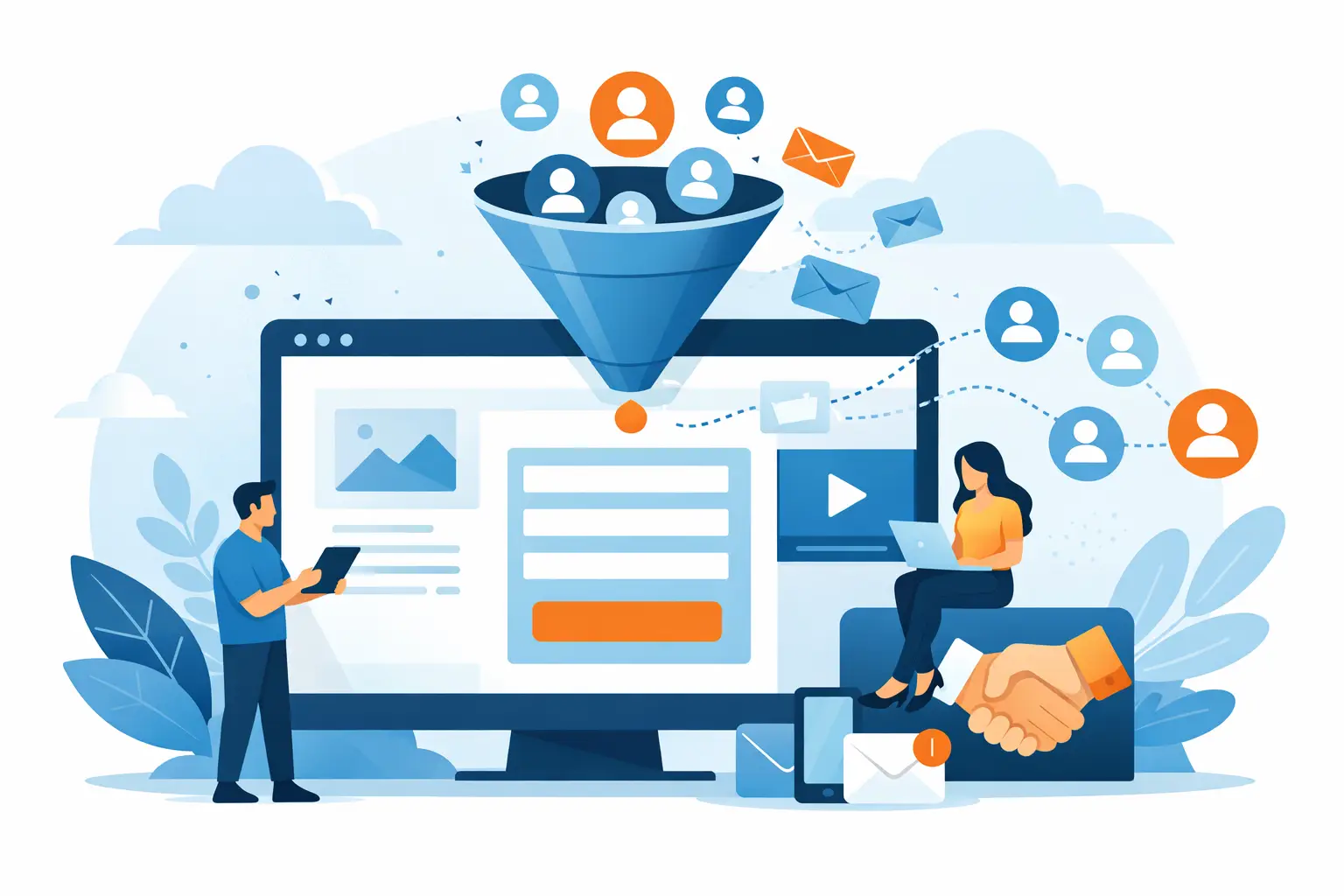
An advertisement can drive hundreds of people to your business in just a few hours. But if the destination is a slow, confusing, or overly informative page, the investment becomes a visit without any real connection. landing page to capture leads It exists to avoid this waste: it focuses the visitor's attention on a single action, such as requesting a quote, scheduling a conversation, or requesting a demonstration.
For a real estate agency, this could mean receiving requests for properties with a defined profile. For a dealership, it means contacts interested in a specific vehicle. For a service company, it means putting the sales team to work talking to people who already understand the value of the solution. The goal is not just to increase the number of registrations. It's to generate opportunities that make sense for the business.
What does a landing page do differently from a website?
A company website presents the company broadly. It talks about services, history, team, location, and other aspects that help build trust. A landing page, on the other hand, works with focus. It is created for a specific offer, campaign, or audience.
Imagine an accounting firm advertising business openings through Google ads. Instead of sending the user to the homepage with dozens of navigation options, it could send them to a page that explains the service, highlights its unique selling points, answers key questions, and provides a contact form. Less distraction, more clarity.
This doesn't mean one format replaces the other. A professional website strengthens digital presence, helps with SEO, and gathers important information for those researching the company. A landing page, on the other hand, acts as a sales tool: it receives traffic from ads, social media, email, or WhatsApp and transforms interest into measurable action.
How to create a landing page to capture leads.
A page that converts doesn't depend on exaggerated visual effects. It needs to quickly answer what the visitor wants to know: what is being offered, to whom, what the benefit is, and how to take the next step.
Start with the offer, not the layout.
Before choosing colors, images, or buttons, define your proposal. “Request a quote” works in many markets, but it can be too generic if it doesn't come with a clear reason. A more specific offer tends to generate more qualified leads.
A clinic can offer an evaluation. A solar energy company can provide a savings simulation. A real estate agency can contact the user to receive options within a specific price range and region. B2B store You can invite the visitor to request a sales table. The best offer depends on the sales cycle and the decision-making level of the audience.
There's also a trade-off to consider. The greater the promised reward, the higher the conversion rate may be, but this doesn't guarantee quality. For example, very broad free material might attract curious people who have no intention of buying. If the priority is to speak to ready buyers, it's worth offering something directly related to the service or product.
Write a message that the customer understands in seconds.
The top of the page is crucial, especially on mobile. The title needs to clearly state the main benefit without vague phrases. “Complete solutions for your business” explains nothing. “Receive a quote to create your online store in up to 15 days” provides context, a timeframe, and an action.
Below, complement the promise with a short explanation. Show what is included, what problem will be solved, and why the company is a good choice. Use business language, but without promising what the operation cannot deliver.
Evidence helps reduce uncertainty. Customer testimonials, real numbers, brands served, reviews, and process details make the offer more concrete. If there's WhatsApp support, team training, or a defined delivery timeframe, present that on the page. The visitor isn't buying code, hosting, or design. They're buying predictability, speed, and a solution that takes work out of their routine.
Ask only for the necessary information.
A lengthy application form scares away some interested parties. Name, phone number, and email are usually sufficient for initial contact. In markets where qualifications are essential, include one or two strategic questions, such as city, investment range, or type of service sought.
The mistake is trying to do all the screening in the first click. The more fields, the greater the user's effort. If your team can qualify the contact later by phone or WhatsApp, keep the entry simple. If the volume is high and the team needs to filter requests, a slightly more detailed form can save time. The decision should align with the company's sales capacity.
The button also needs to indicate what happens next. “Submit” is functional, but not very persuasive. “I want to receive a quote,” “Request a simulation,” or “Speak with a specialist” make the expectation clearer. Repeat the call to action at natural points on the page, without turning every paragraph into a sales pitch.
Make the page load quickly and work on mobile.
Most campaign visits happen via mobile phone. If the page takes a long time to load, has small text, a difficult-to-fill form, or a hidden button, you lose contacts before you even present the offer.
Performance is part of conversion. Heavy images, automated videos, unnecessary code, and limited hosting can hinder loading speeds. A well-developed infrastructure, with optimized files and a server prepared to handle traffic, improves the user experience and reduces the cost of each lead acquired.
Responsiveness isn't just about "fitting the screen." Buttons need to be within easy reach, fields should be easy to fill out, and the message should remain clear on smaller screens. Test the page on your own mobile phone before publishing. This simple precaution often reveals problems that go unnoticed on a computer.
Elements that help generate qualified leads
A landing page designed to capture leads needs to guide the visitor logically. Generally, the page presents the promise, explains the benefits, demonstrates credibility, and provides a way to contact them. Some elements are especially useful when used judiciously:
- A straightforward title that connects the offer to a real customer need.
- An image or video that helps to understand the service, without significantly increasing loading time.
- Objective benefits, such as deadlines, service, cost savings, security, or ease of implementation.
- Evidence of reliability, including testimonials, evaluations, and verifiable results.
- A simple form and a button with a clear call to action.
- A confirmation message that informs you of the next step after registration.
It's not mandatory to use all features in every campaign. A page for a local service requiring quick decisions can be short. A business solution with a larger contract might need to explain steps, technical differentiators, and use cases. What cannot be lacking is consistency between the ad, the page, and customer service.
Paid traffic, SEO, and customer service need to work together.
The page doesn't generate leads on its own. It depends on people reaching it and a team prepared to respond. In paid ads, the creative promise should be the same as the landing page promise. If the ad mentions a budget for... professional website, But the page opens with an offer from an online store, trust drops, and the click is wasted.
For Google Ads campaigns, precision is even more important. Someone searching for "website creation for real estate" expects to find a solution for that segment, not a generic page about digital marketing. Creating pages by service, audience, or region can increase the campaign's relevance, as long as there is no pointless duplication of content.
SEO can also bring in leads, especially for frequently searched offers. However, organic results usually take longer than a paid campaign. For companies that need to generate leads quickly, the combination often works well: paid traffic to accelerate demand, SEO to build a continuous presence, and a good landing page to convert both.
After registration, response speed is crucial. A lead who requested a quote might now be communicating with three competitors. Set up alerts for the sales team, record the origin of the contact, and define who handles each type of request. Automation tools help, but they don't replace a clear and quick human response.
How to measure if the page is delivering results
The number of forms submitted is just the beginning. Track how many visits the page received, what percentage became leads, how much each contact cost, and, most importantly, how many of those contacts turned into proposals and sales.
A high conversion rate can be misleading when leads don't fit the profile. Similarly, a lower rate can be excellent if contacts arrive ready to buy. Therefore, marketing and sales should analyze the data together. Ask the salesperson what messages are received, what objections arise, and where interested parties drop out.
Small tests can yield significant gains. Changing the title, reducing fields, altering the order of benefits, or making the offer more specific are adjustments that help understand audience behavior. Make one change at a time when possible, record the results, and avoid making decisions based solely on personal preference.
Quick Commerce develops fast, responsive pages designed to integrate campaigns, forms, and customer service tools. The focus is on getting your operation up and running with the infrastructure to handle traffic and transform each opportunity into a well-conducted sales conversation.
If your company already invests in advertising but receives few orders, the problem may not be the campaign budget. It could be the seconds that pass between the click and the visitor's decision to fill out the form. A clear, fast page designed for your offer gives your salesperson a much better chance of starting that conversation.